The 300-Hour Gap: What Actually Changes After Your RYT-200
There is a strange silence around the 300-hour yoga teacher training. Enormous amounts have been written about choosing a 200-hour course. Almost nothing useful has been written about the one after it — which is odd, because the people considering it have already spent a month of their lives and a lot of money on the first one, and deserve better than marketing copy.
So: what actually changes between 200 and 300 hours?
The 200-hour course teaches you to teach. The 300 teaches you to see.
That sounds like a slogan, so let me make it concrete.
A good 200-hour training gets you to the point where you can hold a room. You can sequence a class, cue a posture, keep time, project your voice, and get thirty people safely from Savasana back to their shoes. That is a genuine skill and it is not a small one.
What it does not give you — because there isn't time — is the ability to look at a specific human body and know what to do about it. That is what the additional 300 hours are for.
The shift is from delivering a class to reading a student. Concretely, that means:
Anatomy stops being general. In a 200-hour course you learn the shoulder girdle. In a 300-hour course you learn what to do when a student's shoulder girdle will not let them lift their arms overhead, and how to tell whether that is tightness, structure, or old injury — three problems with three different answers.
Adjustment becomes a real subject. Hands-on assists are usually introduced in a 200 and studied properly in a 300: when to touch, when absolutely not to, how to communicate consent, and how to use props and verbal cues instead. This is the area where undertrained teachers do the most damage.
Sequencing gets a theory. Not "here is a sequence to memorise," but why a sequence works — how to build toward a peak posture, how to counter-pose, how to design for a specific population rather than a generic room.
Philosophy stops being introductory. The Sutras get read rather than summarised. Pranayama moves past technique into effect, contraindication, and the actual traditional framework it belongs to.
You teach, and get corrected. Practicum in a 300-hour course tends to be the bulk of the value. Being watched teaching, and told precisely what you did wrong, is uncomfortable and irreplaceable.
The credential question
Practically: 200 hours plus 300 hours makes you eligible to register with Yoga Alliance as an RYT-500.
Be clear-eyed about what that is worth. It will not double your rate. Most studios hiring for a general class do not require it. What it does is open the doors that a 200-hour certificate cannot: teacher trainings, workshops, retreats, specialist work, and the kind of studio position where you are trusted with the difficult students rather than the 7pm beginners' slot.
It also matters more the further you get from a big yoga market. If you are competing against two hundred RYT-200s in a city, the 500 is a differentiator. If you are the only teacher in your town, less so.
Should you do it immediately, or teach first?
This is the question worth thinking hardest about, and the honest answer is: teach first, if you can.
The 300-hour course is enormously more useful once you have taught real classes to real people and accumulated a list of things you did not know how to handle. Students who arrive straight from their 200 are still absorbing the first course. Students who arrive after a year of teaching arrive with questions, and questions are what make the 300 hours land.
A year is a reasonable rule of thumb. Six months is fine. Going directly from one to the other is not wrong — it is just a less efficient use of the same money.
The exception is logistics. If the only window you will realistically get for a month in India is the one immediately after your 200, take it. A slightly less optimal 300-hour course you actually attend beats a perfectly-timed one you never book.

What to look for in a school
Different criteria apply than for a 200-hour course, because you are no longer a beginner and you can tell the difference.
- Teaching practicum hours, stated as a number. If the school won't tell you how many hours you will spend actually teaching and being critiqued, that is the answer.
- Batch size. Even more important than at 200 level. Individual correction is the product.
- Named senior teachers, with a traceable lineage, who are actually present for the course rather than appearing for a guest session.
- A syllabus you can read before paying. Not a themed list of words — an actual breakdown of hours by subject.
- Yoga Alliance RYS 300 registration, if the RYT-500 credential matters to you. A school registered only as RYS 200 cannot deliver the hours you need.
Doing it in Rishikesh
The argument for Rishikesh at 300-hour level is stronger than at 200, for a slightly unromantic reason: cost. A month of residential advanced training in India, food and accommodation included, is generally a fraction of the equivalent in Europe, North America or Australia. That difference is often what makes the second training possible at all.
The argument against is the same as always — the town is saturated, and a good school and a bad school photograph identically.
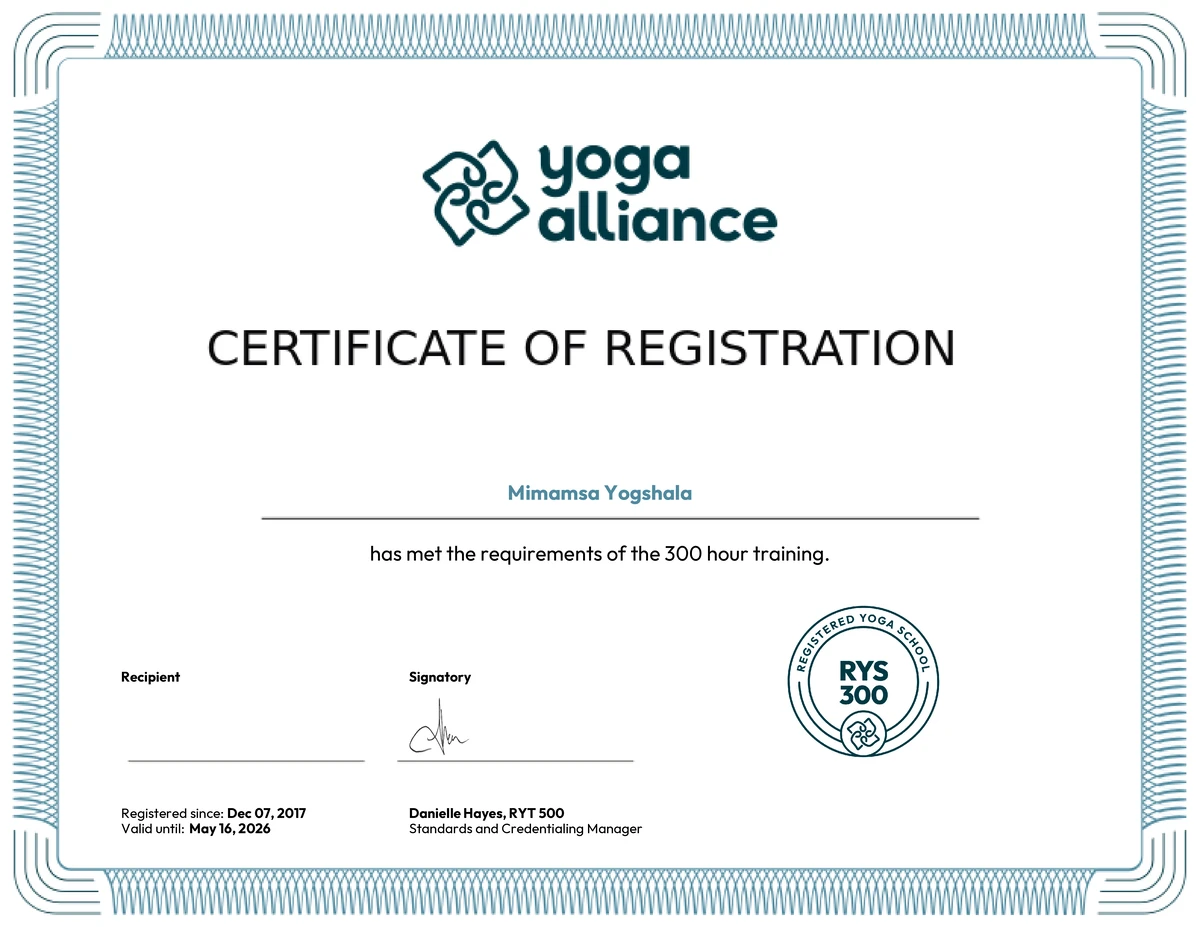
Mimamsa Yogshala runs its 300-hour programme residentially at Swargashram near Ram Jhula, and holds Yoga Alliance registration at both RYS 200 and RYS 300 level, which is the specific thing to check before you book anywhere.
The honest summary
The 300-hour training is not a bigger 200. It is the course where the vague parts of your teaching get made specific, and where you stop performing a sequence and start actually seeing the people in front of you.

It is worth doing. It is worth doing after you have taught. And it is worth choosing the school on practicum hours and batch size rather than on the photographs.

Comments
Post a Comment